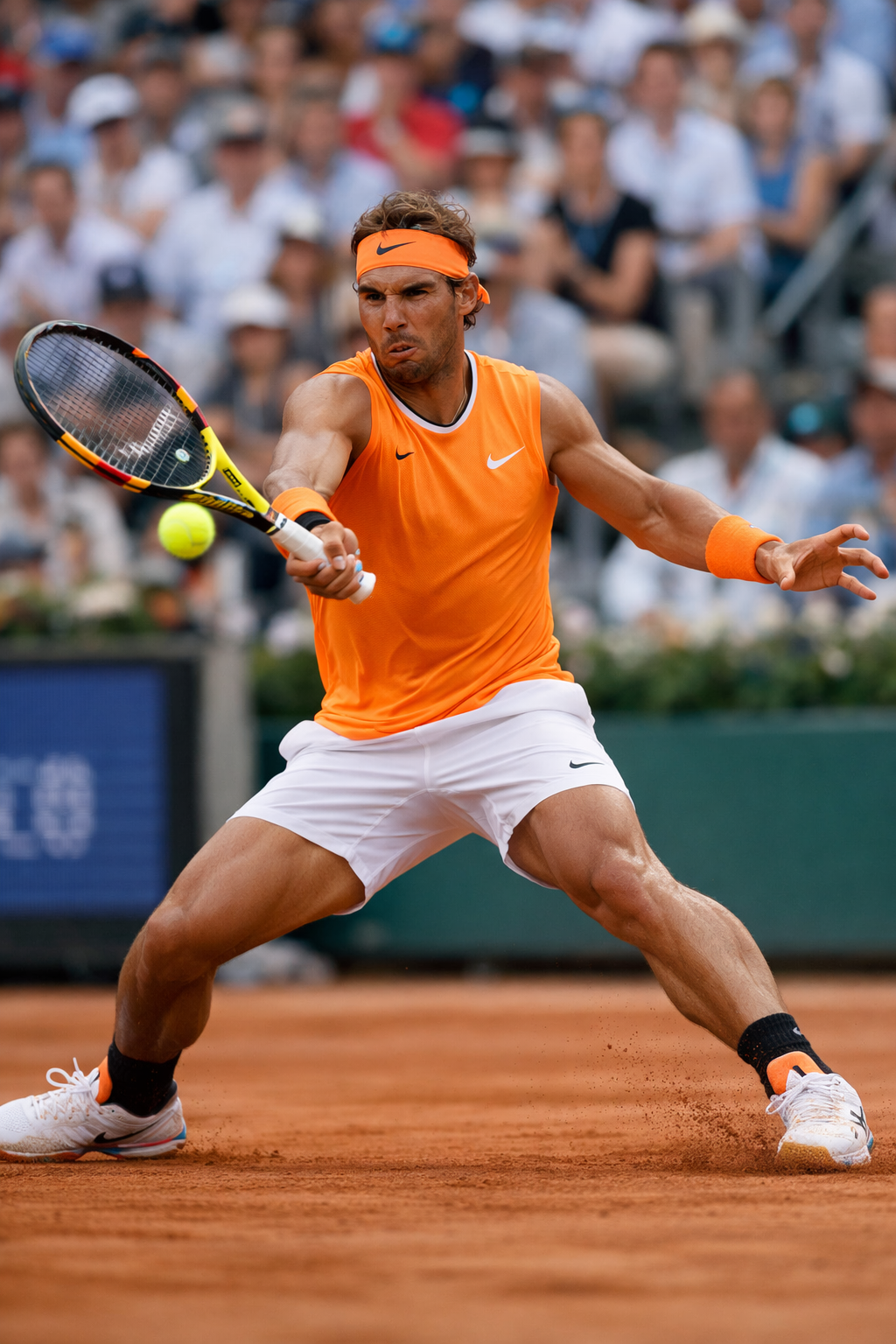
In modern tennis, the open stance forehand has become the dominant forehand technique used by professional players. While neutral and closed stances still exist, the open stance gives players greater power, faster recovery, and superior movement efficiency, especially in high-tempo rallies.
For a coach or competitive player, the reason it is so powerful comes down to biomechanics, court positioning, and tactical efficiency.
Below is the real explanation.
1. The Open Stance Maximizes Rotational Power
The biggest reason the open stance is superior is that it allows maximum hip and torso rotation.
In a neutral stance, energy travels mostly forward through the body.
In an open stance, energy travels through a rotational kinetic chain:
Ground → Legs → Hips → Torso → Shoulder → Arm → Racquet
This rotational sequence produces far greater racquet head speed.
Key mechanics:
The outside leg loads like a spring
Hips rotate violently toward the ball
The torso follows
The arm releases last
This is why players like Rafael Nadal, Novak Djokovic, and Carlos Alcaraz hit such explosive forehands even when pushed wide.
The outside leg becomes the engine.
2. Faster Recovery to the Court
One of the most underrated advantages is recovery speed.
Closed stance:
Momentum moves forward
Harder to recover sideways
Open stance:
Momentum stays lateral
Easier to push back to the center
After contact the player simply pushes off the outside leg.
This is crucial in modern tennis because rallies involve:
heavy topspin
wide angles
extreme court coverage
Without open stance mechanics, players would never recover in time.
3. Better for High Balls
Modern tennis produces much higher bounce heights due to topspin.
The open stance allows players to handle balls around shoulder height or higher.
In a closed stance:
hips get locked
contact becomes jammed
In open stance:
hips stay open
contact stays in front of the body
This is why clay court specialists rely on it heavily.
For example, Rafael Nadal hits many forehands with the contact point well above waist height, something extremely difficult with a traditional stance.
4. Better on the Run
The open stance is the best stance for defensive and semi-defensive situations.
When a player is stretched wide they cannot step across.
Instead they:
Plant the outside foot
Rotate violently
Recover immediately
This allows players to hit off balance but still produce power.
It is the reason the open stance forehand became dominant during the era of:
Roger Federer
Rafael Nadal
Novak Djokovic
The game became too fast for classical footwork alone.
5. Better Use of the Kinetic Chain
Biomechanically the open stance loads the glutes and hips far more effectively.
Key muscles used:
glutes
hip rotators
core
obliques
These are the largest power muscles in the body.
The result:
less arm effort
more effortless power
more spin generation
Players who rely on the arm tend to break down under pressure.
Players who use the legs and hips dominate rallies.
6. Tactical Advantage
The open stance allows players to hit while still moving.
This means players can:
redirect the ball crosscourt
change direction down the line
attack short balls faster
Because the body is already facing the court, the player sees more angles.
This creates aggressive options without repositioning the feet.
7. Works Perfectly with Modern Equipment
The modern forehand evolved alongside polyester strings and modern rackets.
These allow players to swing:
faster
more vertically
with more spin
The open stance supports the modern windshield-wiper forehand motion.
Without it, players would struggle to generate the same spin rates.
When the Open Stance Is NOT the Best
A great player still uses all stances.
Closed stance is still best for:
Attack balls
short balls
inside-out forehands
approach shots
Neutral stance is useful for:
balanced rally balls
stepping into the court
Elite players constantly switch between the three.
The Real Coaching Insight
For junior development, the mistake many coaches make is forcing closed stance fundamentals too long.
Modern players must learn:
open stance loading
rotational power
outside leg recovery
Otherwise they struggle with pace and wide balls later.
In simple terms
The open stance forehand wins because it allows:
Maximum hip rotation
Faster recovery
Better high-ball contact
More power from the legs
Better defense and offense
It is the engine of modern baseline tennis.