
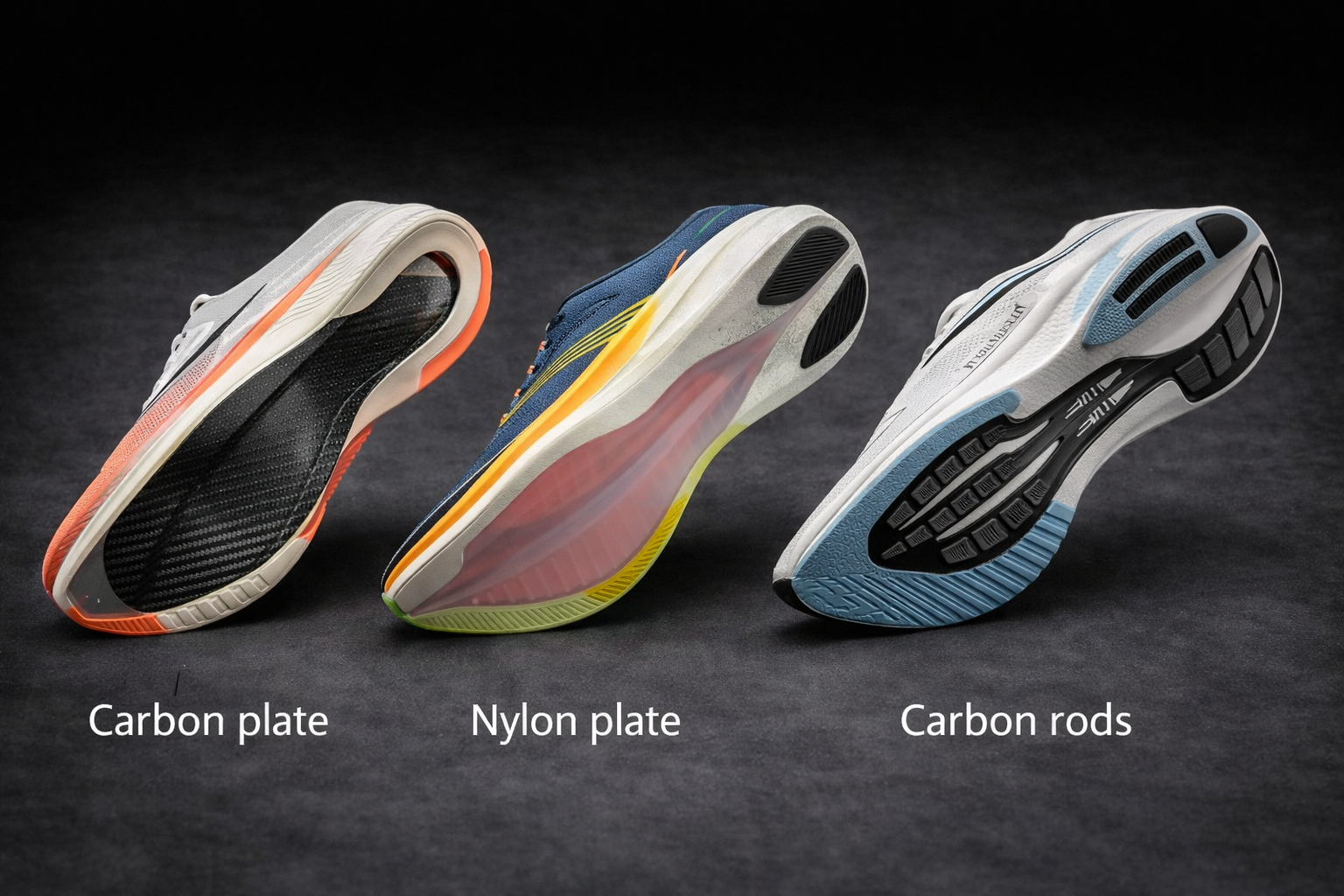
Carbon plate This is the stiffest, most aggressive option. It is usually used in race shoes because it resists bending, works with a rocker shape, and helps push you forward when paired with a soft, highly responsive foam. The upside is maximum propulsion at speed. The downside is that it can feel harsh, unstable, or awkward for slower easy runs. A clean example is the Nike Vaporfly 3, which Nike describes as having a full-length carbon-fibre Flyplate for a stiff, propulsive feel.
Nike.com +1
What it feels like:** Fast, snappy, rigid, efficient when you are running hard.
Best for:
Racing, time trials, fast sessions.
Example shoe:
Nike Vaporfly 3 — full-length carbon-fibre Flyplate. �
Nike.com
2. Nylon plate A nylon plate is usually less stiff and more forgiving than carbon. It still adds structure and a bit of pop, but it bends more naturally and is easier to live with in training. That is why nylon-plated shoes are often the sweet spot for tempo work, threshold runs, and even some daily mileage. A clear example is the Saucony Endorphin Speed 4, which Saucony lists with a re-engineered winged nylon plate that provides reinforcement while maintaining flexibility.
Saucony
What it feels like:
Smoother, more natural, less punishing, still quick.
Best for:
Tempo runs, workouts, long runs with pace, versatile training.
Example shoe:
Saucony Endorphin Speed 4 — winged nylon plate.
Saucony
3. Carbon rods Carbon rods are not one flat plate. Instead, they are separate rod-like elements placed under the foot, usually to follow the metatarsal structure more closely. The idea is to keep a propulsive feel but allow the shoe to work in a way that is a bit more foot-shaped than one rigid slab. Adidas uses this approach in its top Adizero line. The Adizero Adios Pro 4 uses carbon-infused ENERGYRODS 2.0, which adidas says give a seamless heel-to-toe transition and a snappy, efficient stride. �
adidas +1
What it feels like:
Propulsive, but often a bit less “plank-like” than a full carbon plate.
Best for:
Racing and high-end speed training.
Example shoe:
adidas Adizero Adios Pro 4 — carbon-infused ENERGYRODS 2.0.
adidas +1
One important extra point: not every non-carbon plate is nylon. Some brands use Pebax or other polymer plates. For example, the HOKA Mach X 2 uses a Pebax plate, which sits in the middle ground: more forgiving than many race-day carbon plates, but still clearly performance-oriented.
HOKA +2
So in very simple terms:
Carbon plate = most aggressive
Example: Nike Vaporfly 3. �
Nike.com +1
Nylon plate = best balance of speed and usability
Example: Saucony Endorphin Speed 4. �
Saucony +2
Carbon rods = race-tech propulsion in a rod format instead of one sheet
Example: adidas Adizero Adios Pro 4. �
adidas +1
My blunt opinion: for most runners, nylon-plated shoes are the smartest buy because they are far more usable across real training. Carbon plates make the most sense when you are actually chasing pace. Carbon rods sit in that elite-performance world too, just with a different design philosophy.
I can also give you a table of carbon vs nylon vs rods by feel, stability, speed, and best use if you want.
